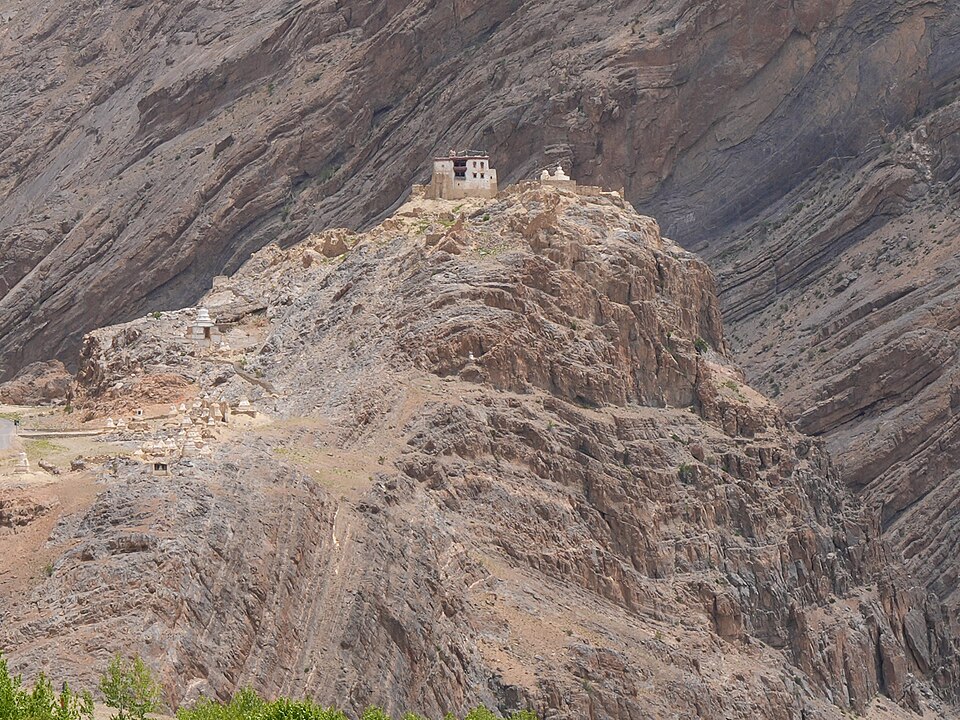
Perched dramatically on a windswept cliff edge high above the Zangla village in the northern Zanskar Valley, Zangla Palace Click to open side panel for more information is the historic seat of the titular King of Zangla. Sitting at an altitude of roughly 3,500 metres, this crumbling mud-brick and timber fortress commands an unobstructed, sweeping view across the fertile floodplains and confluence arteries of the Zanskar River.
Key Highlights & What Makes It Special
- The Hungarian Connection (Alexander Csoma de Kőrös): Beyond its royal heritage, Zangla is world-famous among historians and linguists. In the early 1820s, the Hungarian scholar Alexander Csoma de Kőrös lived here for months in a small, Spartan room attached to the nearby monastic complex, compiling the world’s first Tibetan-English dictionary.
- Dramatic Cliffside Architecture: Built using traditional Ladakhi mud-brick, stone, and poplar timber construction, the multi-story palace clings precariously to the eroded rock face. While weathered and partially ruined by decades of harsh winters, its ancient prayer rooms, decaying royal quarters, and rooftop vistas offer a raw glimpse into Zanskar’s feudal past.
Essential Things to Do
1. Explore the Crumbling Citadel & Rooftop Overlook
- The Climb: Reaching the fort requires a steady, steep 15-to-20-minute uphill walk from the village parking area along an unpaved, dusty slope. The thin air at 3,500 metres makes this short climb feel much more intense than it looks.
- Rooftop Panorama: Navigate the interior staircases (exercise extreme caution around sagging floors, crumbling mud walls, and low lintels) to reach the upper roof terrace for panoramic 360-degree views of the valley floor and surrounding snow peaks.
2. Visit the Csoma de Kőrös Cell
- The Scholar’s Workspace: Walk down toward the nearby village/gompa area to view the modest, preserved cell where Csoma de Kőrös endured freezing sub-zero winters writing his foundational dictionary.
Logistical Realities & Safety Rules
- Structural Decay Warning: Zangla Palace Click to open side panel for more information is not a commercially restored museum park. It is in a state of advanced natural decay. Parts of the flooring, stairwells, and outer walls are fragile or unstable. Watch your footing carefully and avoid leaning against compromised parapets.
- Zero Commercial Infrastructure: There are no ticket counters, official guides, restrooms, or cafes at the site. Carry your own water and supplies.
- Wind and Sun Exposure: Perched entirely in the open on a high ridge, the fort acts as a natural wind funnel. Bring a windproof jacket, hat, and sunglasses regardless of how calm it feels down in the valley village.
Travel Details & Practical Info
- Recommended Duration: 1.5 to 2 hours (Including the uphill hike from the village, exploring the fort interior, and visiting the historic scholar’s cell).
- Best Time to Visit: Morning or late afternoon. Midday sun on the barren rock slopes can be punishingly intense during peak summer months.
- How to Get There: Located roughly 35 km north of Padum along the valley loop road. It is easily combined as a half-day trip when exploring the northern Zanskar route toward Zangla village.
- Honest Framing: Zangla Palace Click to open side panel for more information is a crumbling, atmospheric historical ruin rather than a polished tourist attraction. Go for the profound historical legacy, the solitude, and the unmatched cliffside views over the valley, but respect its fragile physical state.